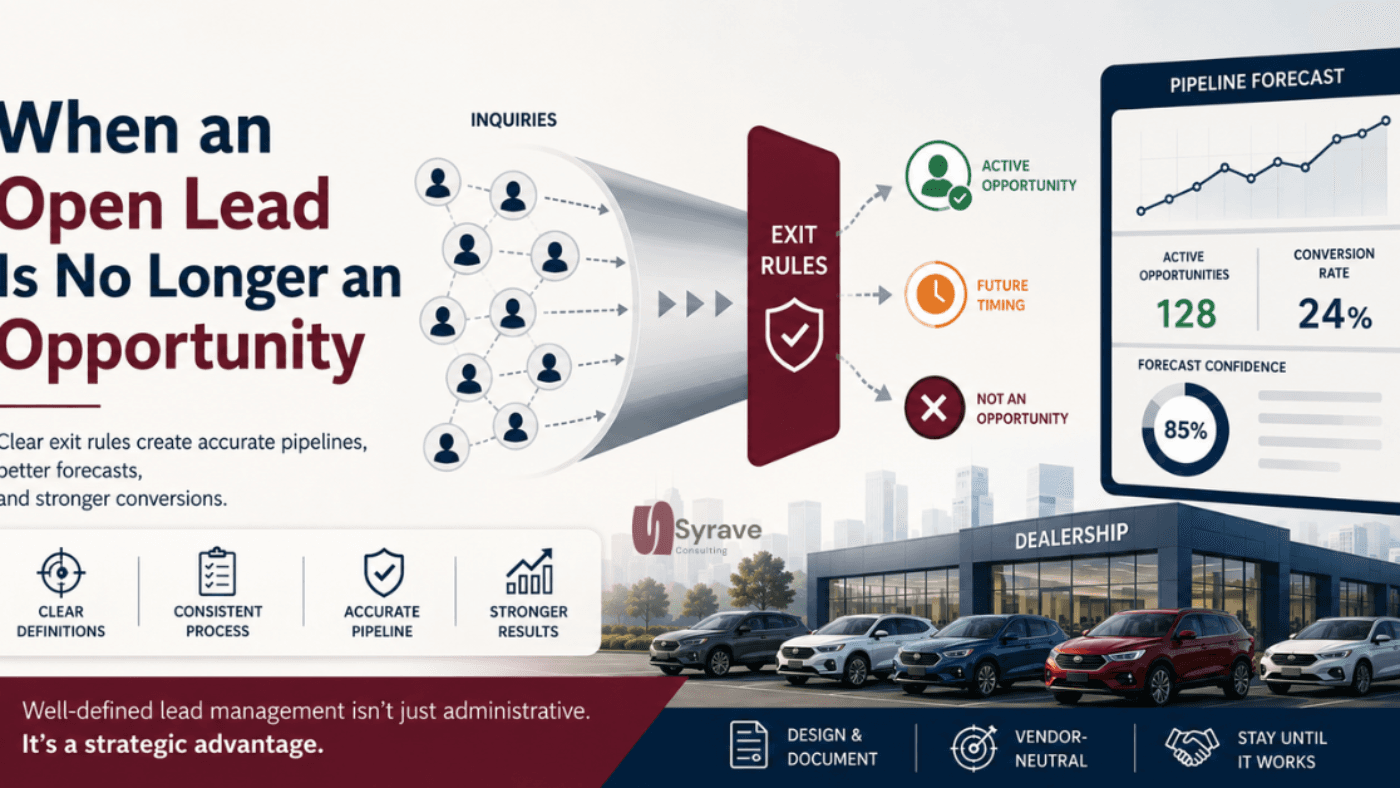
When an Open Lead Is No Longer an Opportunity
A dealership general manager opens the weekly pipeline report and sees a healthy number of active opportunities. The sales team is working. Marketing is generating inquiries. On paper, next month looks promising.
Then the month closes below plan, and the explanation offered is that the market softened.
Often, the market did not soften. The pipeline was describing buyers who had already purchased somewhere else. Nobody had updated the record because the operating model never required a clear decision.
This is one of the quieter failures in automotive lead management, and it is rarely a discipline problem within the sales team. It is a design problem. Few organizations ever define when an open lead should cease to be treated as an active opportunity.
A Pipeline Report Is Only as Honest as Its Exit Rules
Most dealership pipelines receive considerable attention at the front end. Lead sources are tracked, inquiries are captured, and ownership is assigned. The intake process is usually well defined.
The exit, however, is often left undefined.
An undefined exit creates a predictable outcome. Leads continue entering the pipeline, but very few leave it. Closing a lead requires someone to make a negative decision, yet most operating models neither require that decision nor reward it. As long as there is a possibility that a customer may return, the record remains open. The pipeline continues to look healthy, while its ability to represent genuine opportunities steadily declines.
The consequence extends beyond inaccurate reporting. New enquiries now compete for attention alongside months-old records carrying exactly the same status. Genuine opportunities begin to slip through the cracks while managers continue believing the pipeline is full.
The discussion then shifts toward generating more leads, when the real issue is that existing leads were never properly resolved.
If your pipeline continues to grow while conversion remains flat, the problem is often not lead generation. It is the absence of clear exit rules rather than a lack of sales effort. Before increasing advertising budgets or introducing new technology, leadership needs confidence that every lead status carries the same meaning across the organization.
If this challenge sounds familiar, our Lead Management System Design service helps dealer groups document the operating definitions behind reliable pipeline reporting before additional investment is committed.
What Lead Management Design Needs to Settle First
The instinct in this situation is often to configure the CRM differently or build another dashboard. Neither addresses the underlying issue until the business first agrees on a common operating standard across every dealership.
That begins with a small number of decisions that need to be documented rather than assumed. The business must define what qualifies a lead as closed, who has the authority to make that decision, and when prolonged silence from a buyer should be treated as a concluded outcome instead of an open opportunity. It also needs to decide how buyers should be managed when their timing is wrong but their purchase intent remains genuine, and which of these definitions must remain consistent across every branch while still allowing room for local judgment.
These may appear to be administrative decisions, but they determine what every pipeline report actually represents. When those definitions vary between branches or individuals, forecasts, inventory planning, staffing decisions, and advertising investment are all built on inconsistent information.
Most dealer groups can answer these questions. What they rarely have is the time, the mandate, and the neutral position required to settle them, document them clearly, and apply them consistently across every branch.
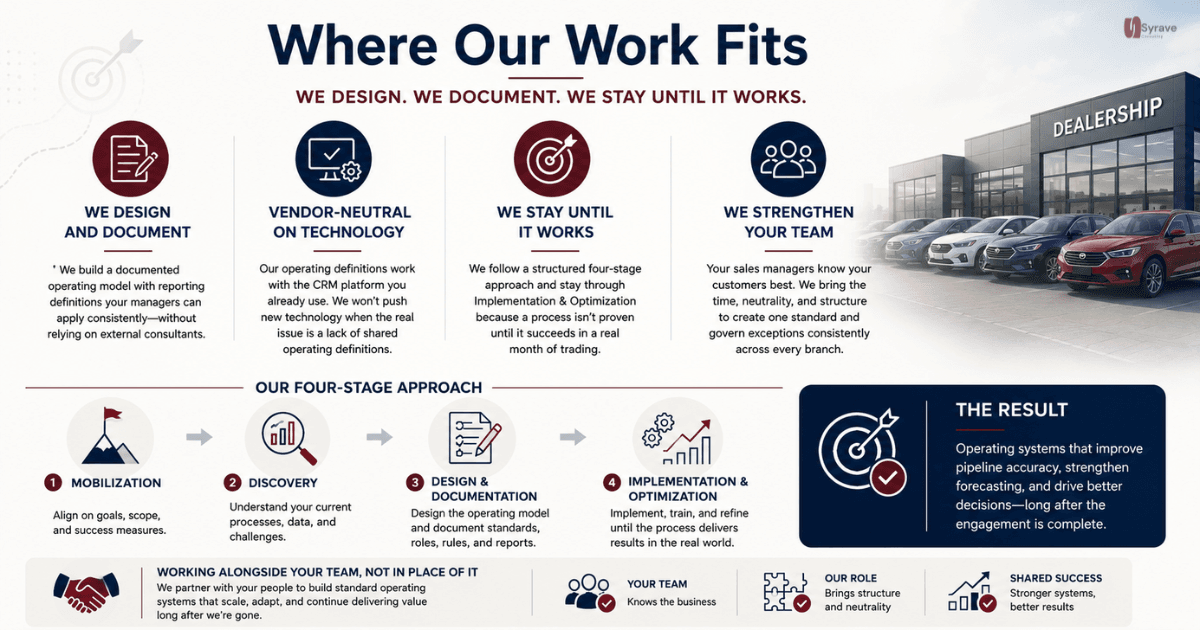
Where Our Work Fits
At Syrave, we design and document rather than advise and depart. The outcome is not a recommendation deck. It is a documented operating model supported by reporting definitions that managers can apply consistently without relying on external consultants after the engagement has ended.
We are vendor-neutral on technology. The operating definitions we design can be configured into the CRM platform your dealership group already uses. We have no incentive to recommend replacing a system when the underlying issue is the absence of shared operating definitions.
We also stay until it works. Our engagements progress through four structured stages: Mobilization, Discovery, Design & Documentation, and Implementation & Optimization. The final stage matters because a process has not been proven until it has operated successfully through a real month of trading.
This work is designed to strengthen the team you already have. Your sales managers understand your customers better than any external consultant ever will. What they often lack is the time and neutrality required to step outside the daily operation, agree on one operating standard, and govern exceptions consistently across every branch.
That is where we come in, working alongside your team rather than in place of it. Our role is to help build operating systems that continue supporting the business long after the engagement is complete.
Start with an Honest Look at Your Pipeline
If your sales forecast and actual vehicle deliveries consistently tell different stories, the quickest place to begin is by examining how leads leave your pipeline today.
We offer a complimentary 60-minute Discovery Call.
No pitches. No commitments. Just a direct review of your current lead management process, an honest assessment of what is working, and practical feedback on where stronger operating definitions can improve forecasting, reporting, and conversion.
Cần tư vấn xây dựng đội ngũ nhân sự?
HR4U luôn sẵn sàng đồng hành cùng bạn.