The Buyer Who Took the Test Drive, Then Bought Somewhere Else
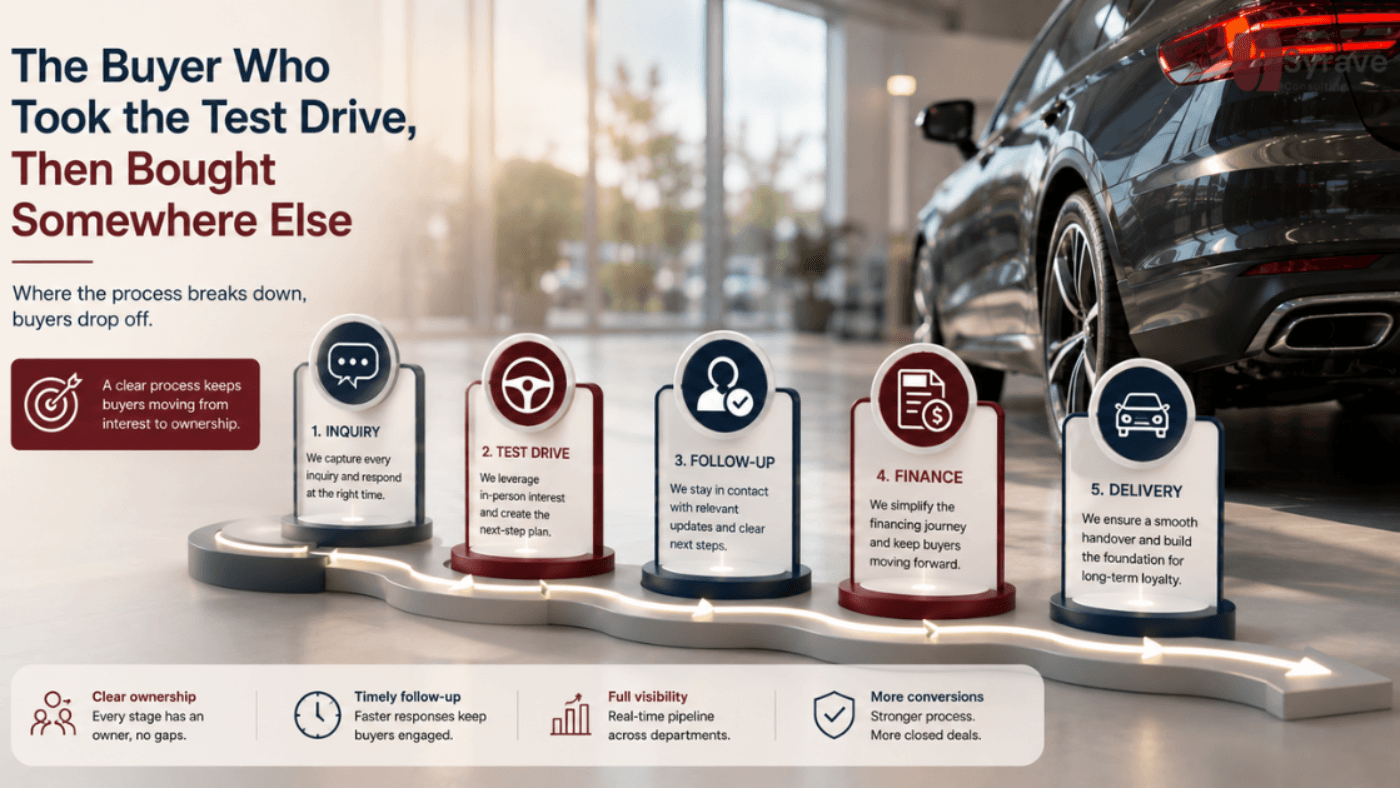
A customer walks into your dealership, asks informed questions, takes a test drive, and leaves genuinely interested. The sales team believes the opportunity is progressing, and everyone assumes the next conversation will happen naturally. A week later, no one is certain who was meant to follow up. A month later, that customer has bought the vehicle from another dealership.
This is one of the most common failures in automotive lead management, and it is rarely caused by weak marketing or thin customer interest. The opportunity is usually lost in the transition between departments, where responsibility changes hands without a defined process to keep the buyer moving forward. The loss is not only revenue. It is a customer journey that depends on individual effort rather than a repeatable system.
The most critical stage happens after the test drive
Generating inquiries is only the beginning. The real challenge begins once a customer has shown genuine buying intent, because from that point every handoff and follow-up influence whether the buyer continues toward a purchase or quietly leaves the pipeline.
Unlike most retail purchases, buying a vehicle involves several departments before the sale is complete. Customers move between sales consultants, business development representatives, finance specialists, and delivery teams. Each may perform well alone, while the buyer’s experience depends on the transitions between them. Where those transitions are inconsistent, buyers meet delays, repeated conversations, or silence, and their confidence erodes before anyone internally notices.
Where the process breaks down
Handoffs happen informally. A consultant finishes a test drive, mentions the customer to a colleague, and intends to call later in the day. If priorities shift or someone is unavailable, the customer may receive nothing at all. Progress then depends on individual memory, which is least reliable in exactly the periods when the showroom is busiest.
Information is recorded when time allows. A CRM platform gives visibility across the journey only when information enters it consistently. Where visits, calls, and updates are logged as time permits rather than as a standard step, the system reflects activity rather than reality, and no colleague can continue a conversation with confidence because the context is missing.
Ownership is unclear at the transitions. After a test drive, who arranges the next conversation. If a financing discussion stalls, who ensures the customer receives an update. If a buyer goes quiet for several days, who reconnects. Where these answers are undefined, small gaps between departments compound into lost opportunities.
The instinct at this point is to invest more heavily in advertising, but volume cannot resolve an operational gap. If qualified buyers are already leaving after visiting the showroom, more leads simply create more opportunities to lose them.
If your team would describe the sales process differently depending on who you ask, the gap is in the design rather than the effort. That is worth an hour of conversation.
Designing automotive lead management around the whole journey
The answer is not asking staff to work harder or reminding them to make more calls. Sustainable improvement comes from a lead management system that defines every stage of the journey and establishes accountability at each transition.
An effective system carries every inquiry through a structured route, from first contact to vehicle delivery. Each stage has an assigned owner, an expected response time, documented follow-up, and visibility across departments. Teams stop relying on individual habits and work to shared standards instead, so management gains a reliable view of the pipeline and fewer opportunities slip through the cracks.
How Syrave strengthens automotive lead management
Our engagement runs through four stages. Mobilization aligns leadership around objectives and priorities. Discovery maps how customers actually move through the dealership, including the informal workarounds staff rely on every day. Design and Documentation produces the stage definitions, ownership rules, and follow-up standards that become part of daily work. Implementation and Optimization is where we stay until it works, alongside your team, under real trading conditions.
We design and document, rather than advise and depart, so each project leaves practical assets behind. We are also vendor-neutral, designing around the systems the dealership already owns, because in most cases the technology is not the problem. The harder task is getting people, process, and system to work together with clear accountability, and that work is developed with the consultants, finance specialists, and managers who understand how your buyers behave in practice.
When a serious buyer goes quiet after a test drive, the loss is easy to attribute to market conditions or indecision. More often it is the predictable output of an undesigned process. Customer progress does not happen by chance. It happens by design.
Find out where buyers are slipping through the cracks
If buyers become unresponsive between the first inquiry, the test drive, the financing discussion, and delivery, examine the process rather than the people.
Syrave offers a complimentary 60 minute Discovery Call to review how buyers move through your dealership, identify where handoffs break down, and advise on where to improve first. No pitches, no commitments. A direct audit of what you have today and honest feedback on what is missing.
Cần tư vấn xây dựng đội ngũ nhân sự?
HR4U luôn sẵn sàng đồng hành cùng bạn.