
The Number Missing From Your Revenue Decline Conversation
1.The Explanation That Is Already on the Table
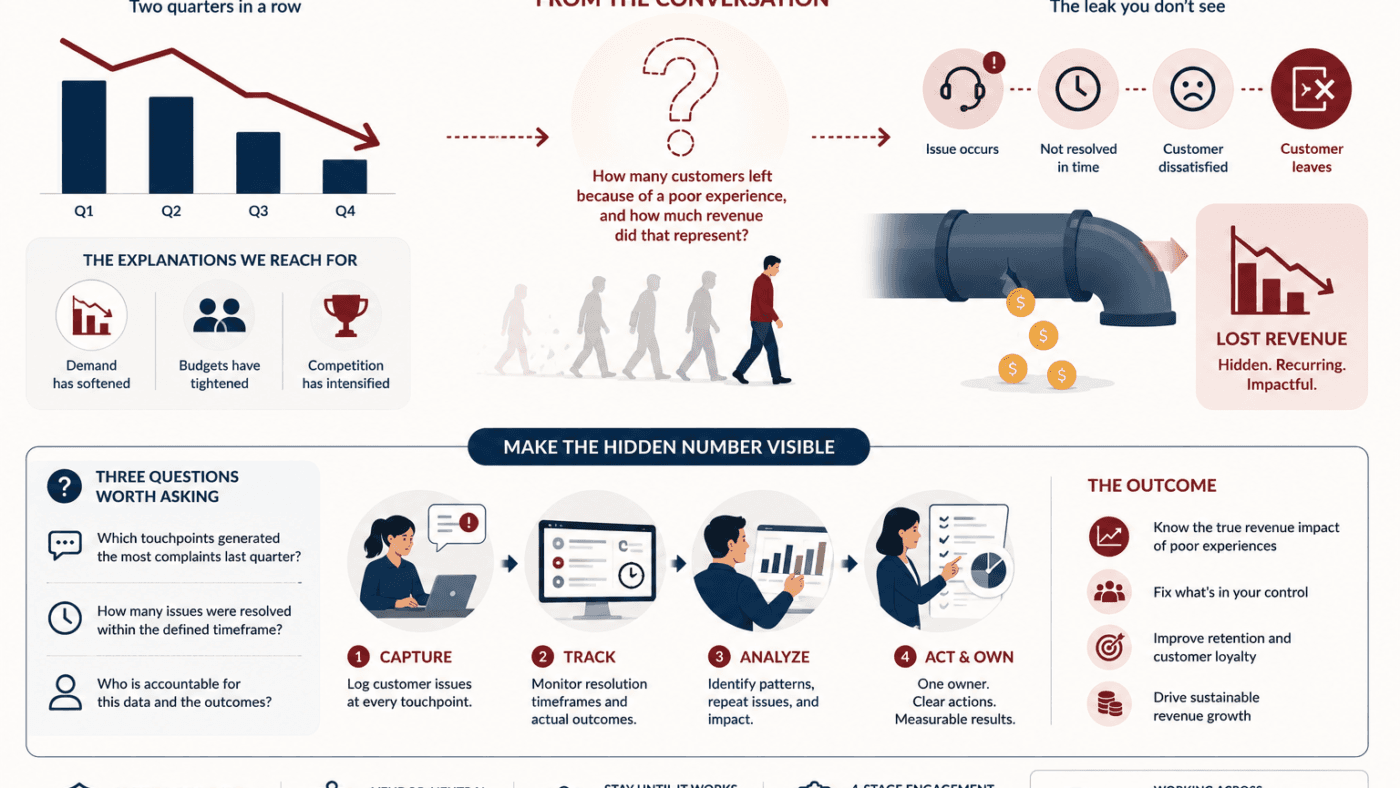
Revenue has declined for two consecutive quarters, and by the time the strategic review comes around, the explanation is usually already prepared: demand has softened, budgets have tightened, competition has intensified. These explanations are not wrong, and in most cases they account for part of what happened but they share a common trait, which is that they all point outward, toward the market, and none of them require the business to look at its own operation.
There is one number that rarely makes it into this conversation, and it is the number that sits closest to home: how many customers left over the last two quarters because of a poor service experience, and how much of the revenue decline that represents.
The reason this number is missing is not that it does not matter. It is that, for most businesses, it does not exist.
2.Why the Signal Disappears Before It Can Be Measured
Most customers who leave after a poor experience do not escalate, file a complaint, or provide formal feedback on their way out. They simply stop returning, and from the business’s perspective, a customer who stops returning looks identical to a customer who was never going to be retained in the first place both show up as the same line in the same report, and neither one is flagged as a service failure unless someone specifically goes looking for that connection.
Without a mechanism to capture that signal at the point where it occurs at the service touchpoint itself, before the customer has decided not to come back the revenue impact of poor service stays invisible. It does not disappear. It gets absorbed into the market narrative, quarter after quarter, indistinguishable from the demand and competition effects that are easier to talk about because they do not implicate the operation.
Before the next strategic review, it is worth knowing whether this number exists in your operation at all. Syrave offers a focused 60-minute Discovery Call to help you find out: no pitch, no commitment.
Booking meeting now or email mkt@syrave.vn
3.Three Questions Worth Asking Before the Next Review
These three questions are not difficult to ask, but in most operations they are difficult to answer and the difficulty of answering them is itself the diagnosis.
• Can your operation tell you which service touchpoints generated the highest volume of customer complaints or negative feedback last quarter?
• Do you know how many of those issues were resolved within a defined timeframe, and how many were not?
• Is there a single person in the organisation accountable for that data for collecting it, reviewing it, and acting on what it shows?
If the answer to any of these is no, the gap is not a reporting gap. It is an infrastructure gap, because the data these questions ask for does not get generated automatically it requires a system that captures complaints and service issues at the point they occur, tracks them against a resolution timeframe, and assigns ownership for the outcome. Where that system does not exist, the questions cannot be answered no matter how carefully the existing reports are reviewed, because the underlying data was never collected in the first place.
This is also why the gap tends to persist quarter after quarter without anyone deciding to leave it unaddressed. Nobody chose not to track this. The infrastructure to track it was simply never built, and in its absence, the market narrative fills the space not because it is necessarily wrong, but because it is the only explanation for which data is readily available.
4.Syrave’s Approach: Making the Hidden Number Visible
Syrave approaches this as an operational design problem rather than a reporting problem, because the reason the number is missing is that the underlying infrastructure to generate it does not exist yet adding it to a dashboard would simply produce an empty field.
Service touchpoints are mapped and instrumented for complaint capture. The first step is identifying where in the customer journey dissatisfaction is most likely to occur and most likely to go unrecorded, and building a structured way to capture it at that point not relying on the customer to escalate, but giving the team a defined way to log the issue as part of their normal workflow.
Resolution timeframes are defined and tracked against actual outcomes. A complaint that is logged but never resolved, or resolved without a defined timeframe, produces a record without producing accountability. Syrave designs resolution targets for each touchpoint type and builds the tracking that shows, for any given period, how many issues were resolved within that target and how many were not.
A single owner is assigned for the resulting data. The data is only as useful as the accountability structure around it. Syrave defines who reviews this data, on what cadence, and what action is expected when the numbers indicate a specific touchpoint is generating a disproportionate share of complaints or missed resolution targets.
The outcome is not a dashboard for its own sake. It is the missing input to the strategic review a number that can sit alongside the market explanation, be weighed against it, and tell leadership how much of the revenue movement is something the operation can actually act on.
5.The Market Will Recover or It Will Not. This Gap Will Not Close on Its Own.
The market explanation for a revenue decline may turn out to be the right one, or the market may recover on its own timeline regardless of what the business does. But the operational gap the absence of a mechanism to see how much of the decline is coming from customers who left over a poor experience will not close by waiting, because it is not connected to the market cycle. It is connected to whether the infrastructure to capture that signal exists.
Set aside 60 minutes for a Discovery Call with Syrave. We will help you assess whether this number exists in your operation today, and if it does not, what it would take to build the infrastructure to generate it no pitches, no commitments. Direct audit. Honest feedback.
Need help building your HR team?
HR4U is ready to support you every step of the way.